What is a Website’s Logical Structure and Why is it Necessary



A well-designed website structure serves as its foundation. There is no single universal option that fits every niche. Each project requires its unique approach. This article delves deeper into the concept of a logical structure and its role, as well as search engine requirements.
What is a Website’s Logical Structure?
A website’s logical structure is a collection of all its pages, considering hierarchy. In other words, it relates to the pages, their interconnection, and their affiliation to specific sections and categories on the site.
The structure should be built in a way that facilitates user interaction. If the hierarchy is poorly assembled, clients might get confused, frustrated, leave your site empty-handed, and as a result, foster a negative association with your company.
Importance of Website Structure for Search Engines
Each search engine has its list of requirements for website structures. Below are Google’s recommendations:
- First and foremost, remember the logical hierarchy. It should be simple for users to find what they are looking for, usually aided by breadcrumb navigation;
- Use text links instead of banners. This allows the system to evaluate the site’s relevance faster and more accurately;
- Optimize 404 pages. Make them informative, provide links for navigation. This ensures users remain on your site, continuing their search for desired information;
- Make links user-friendly. They are easier for users to understand and remember, and they look neater externally. For instance, instead of https://prflare.com/ru-ru/search=seo/?orientation, a better option would be https://prflare.com/search/seo;
- Use simple structures in catalogs so users don’t get confused;
- Your site should have a unique address, so avoid using URLs for multiple documents.
Why is a Proper Website Structure Important?
The site structure is an essential element for both search engines and users. Below are the advantages of a well-designed website structure:
- Improved usability. When the site’s navigation is simple and comprehensible for users, they not only quickly find the information they need but also stay longer on your resource, returning to it, and leave with a positive impression of your company.
- Faster page indexing. Logical structure gives insight into which resource pages are most necessary for the webmaster and user. Typically, the three-click rule is used (the most important pages shouldn’t be further than three clicks from the homepage).
- Fewer technical errors. A correct structure helps avoid duplicate pages, saving on promotion budget.
- Covers a large number of requests. Creating categories, sections, and subsections for narrow groups helps rank for various key terms. As a result, these pages appear in search results for niche topics, attracting organic traffic.
- Proper distribution of link weight. It’s crucial that many internal links lead to the promoted page.
What Types of Website Structures Exist?
To choose the most suitable structure for your project, you initially need to understand the types. We will examine linear, block, and tree structures in more detail.
Linear Structure

In a linear structure, there is no hierarchy, and all pages are equal. They read like a book. This structure is best chosen for landing pages or business card/presentation sites because promotion is only possible for the main page. The link weight is transferred from the main page to all subsequent pages.
Linear Structure with Branches
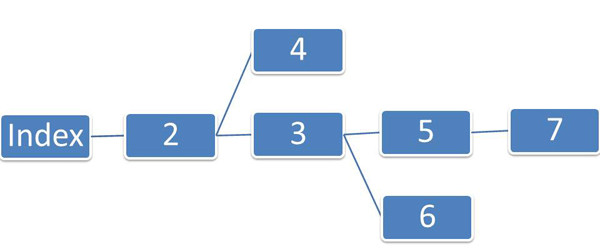
Here, the same scheme remains as in a regular linear structure. The difference is the branches along the chain. Such a structure is also best used for landing pages, business card sites, online books, etc.
Block Structure
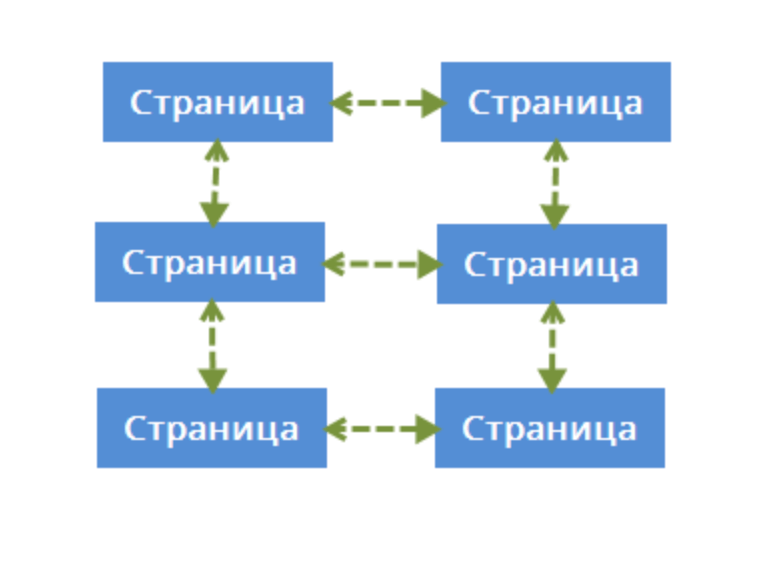
In such a structure, all pages are equal, except for the main one. Each block references several others, arranged next to each other, while the link weight is distributed evenly.
The block structure positively influences site indexing. It’s best suited for a specific product or service. It’s quite complex to implement and therefore not common.
Tree Structure
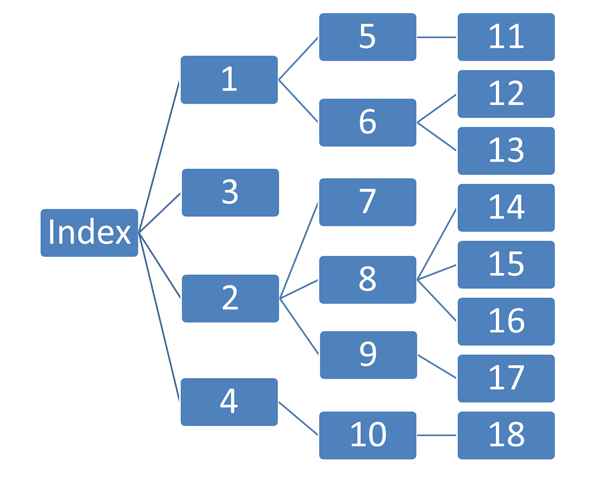
This type of structure is the most optimal for SEO as it displays a clear hierarchy. Tree structures are the most popular and often seen, as they fit almost any project. They are used for online shops, informational portals, etc.
Main Errors in Website Structure Creation
Errors in the process of creating a website structure often create many problems later for its owner and the user. Below are the most common oversights:
- Optimization for different intents. It’s common to see combined categories on sites, for example, “books and board games”. However, it’s more optimal to separate this phrase and assign books one section and games another, as few people enter these two items simultaneously in their query. This way, your traffic will increase.
- Duplicate pages. If a webmaster adds the section “natural cosmetics” and then adds “natural cosmetics” in filters, the site will have two identical pages. The search engine will be confused during issuance, and your resource’s relevance and positioning will be worsened.
- Unclear duplicates. This issue is also called “page cannibalization”. Sometimes webmasters create separate pages for very similar requests. For example, budget kitchenware, affordable kitchenware, cheap kitchenware. This mistake will lead to indexing problems.
- High degree of nesting. We mentioned the three-click rule earlier. Try to organize your site so that all crucial pages are within three clicks of the homepage, as resources with the fourth and higher nesting levels index poorly.
- Lack of a sitemap. If your project is large enough, the sitemap should be its integral part. Two should be created: for users and for search bots.
In Conclusion
A website’s logical structure is the foundation and key to a successful web page. To make this process as effective as possible, pay attention to search engine requirements and recommendations. There are four types of logical website structures:
- Linear;
- Linear with branches;
- Block;
- Tree.
Try to avoid mistakes when creating the site structure as they can create many problems in the long run. The main errors include:
- Duplicate pages;
- Unclear duplicates;
- Optimization for different intents;
- High degree of nesting;
- Absence of a site map.